|
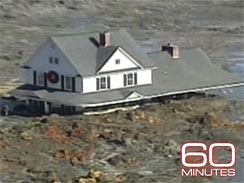
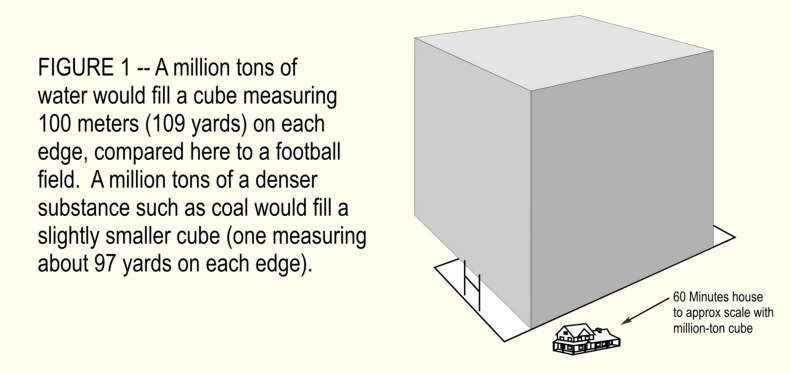
--Kingston, Tenn. was flooded with coal ash when a giant retention pool containing the substance buckled in December 2008, according to 60 Minutes which reports on its website that 130-million tons of ash comes from coal combustion each year. --"American dogs and cats create 10 million tons of waste a year," it is written at the website of Green Planet. --"Azerbaijan will transport about 5 million tons of Kazakh oil in 2009," reports Today.Az. The numbers are precise, and perhaps accurate, but they don't give a feel for the volume filled by a million tons of something. Diagrams of cubical volumes help visualize such things. For example, FIGURE 1 shows the size of a cubical volume that could contain a million tons of water in relation to a football field. These are metric tons, btw, with "tons" sometimes written as "tonnes."
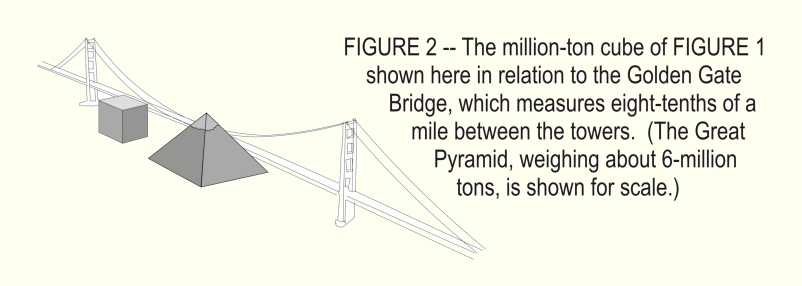
FIGURE 2 shows the same million-ton cube in relation to the Golden Gate Bridge, with the Great Pyramid of Giza (~6 million tons) for comparison. (If the pyramid seems small for ~6-million tons, I've tried to take the density of rock into accout, about 2.5 times that of water.) The cube measures 100 meters (109 yards) on each edge. A millions tons of coal, which is denser than water, would fill a cube that would appear only slightly smaller, measuring about 97 yards on each edge. (Click on the FIGURE for a larger view.)
The size of the human population is always of interest. As I write this in 2007, it is about 6.6-billion, a large number that can give the impression that the earth is packed with people standing shoulder to shoulder. In fact, the land area inside the Beltway around Washington, D.C., could provide standing room for every human being, with slightly more than one square foot per person. (If everyone were to stand inside the D.C. Beltway, they wouldn't stand for long: the metabolic energy output of 6.6-billion standing people is close to the amount of energy that would come from the detonation of one Hiroshima-size bomb every minute. Also, the ground-level oxygen would rapidly become an unbreathable mixture of carbon dioxide and nitrogen, and the humidity would be unbearable.)
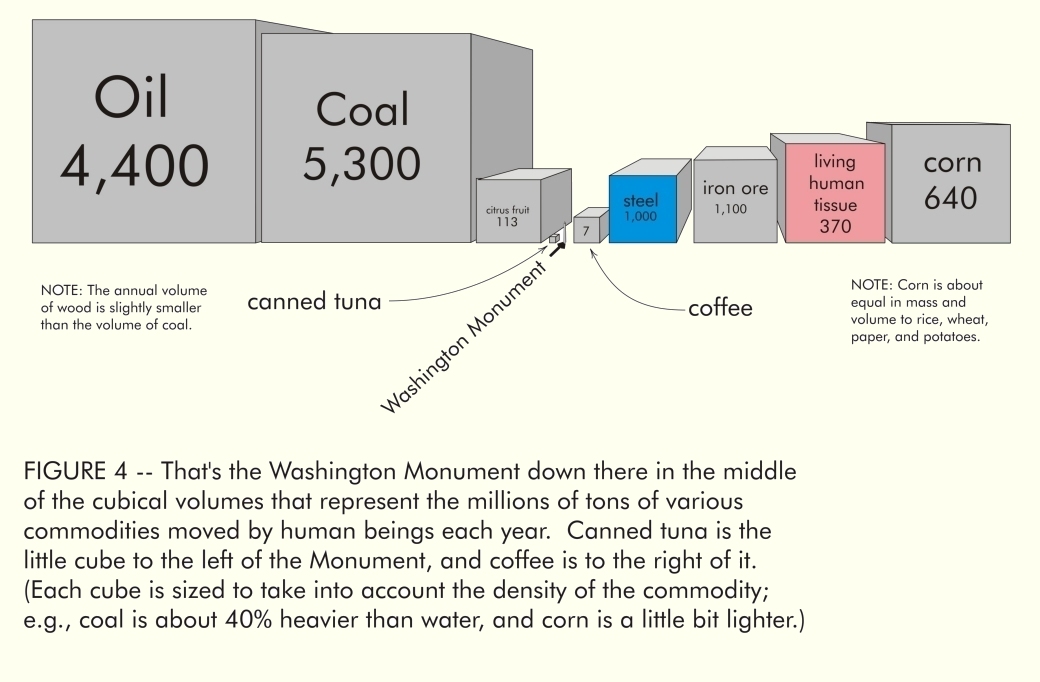
The volume of all living human tissue works out to ~1/11th of a cubic mile, which corresponds to a cube measuring a little less than half a mile on each edge. FIGURE 3 shows such a cube in relation to a map outline of Washington, D.C., which would itself appear as barely a speck when North America is viewed from say 2,000 miles in space or from that same virtual distance on Google Earth. The smaller cube in FIGURE 3 is the 1-million-ton cubical volume of FIGURES 1 and 2. (By the way, that cube of all living human tissue has a mass of 375-million tons.) It is said that ants are much stronger than humans, that they can carry ten times their body weight. But when it comes to the industries of human beings, such as mining and agriculture, humans can also move large amounts of stuff. Each year, the 375-million tons of human tissue in the world moves more than 20 times its weight in coal, oil, iron ore, agricultural materials and other goods. FIGURE 4 shows cubical representations of millions of tons of various commodities in comparison to the Washington Monument. (Each cube is scaled to take into account the density of the commodity; e.g., coal is about 40% heavier than water, and corn is a little bit lighter.)
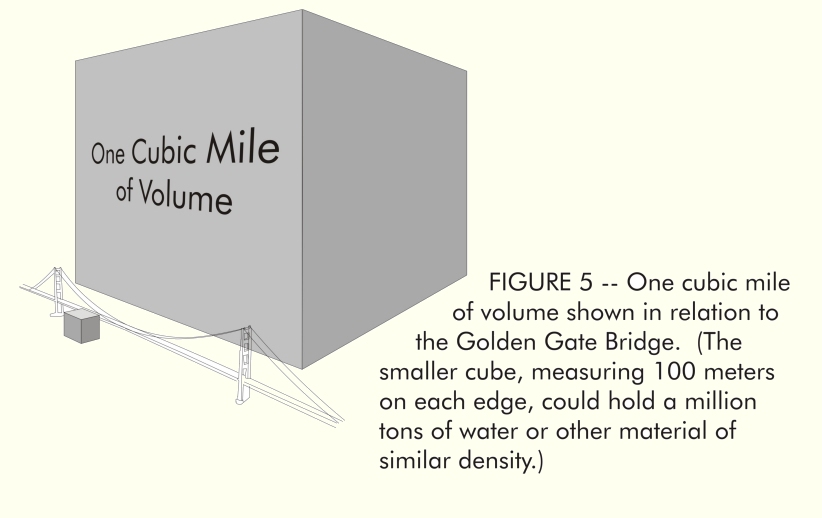
Gaseous volumes, such as that of the carbon dioxide produced by human activities, take up much more volume than do solids such as iron ore and corn or wheat. Cubic kilometers or cubic miles can be useful for representing the likes of annual natural gas production or carbon dioxide production. FIGURE 5 shows one cubic mile of volume in comparison to the Golden Gate Bridge. Web citations of total world carbon dioxide emissions vary from about 10-billion tons/year to 30-billion tons/year; assuming 15-billion tons per year, the annual volume works out to slightly more 1,800 cubic miles which, if lined up beside one another could extend from San Francisco to Mexico City. One estimate of world carbon dioxide emissions by 2030 corresponds to 4,900 cubic miles per year, which could extend from San Francisco to London. The increase in atmospheric carbon dioxide over the last 200 years is about 90,000 cubic miles enough one-mile cubes to circle the earth almost four times.
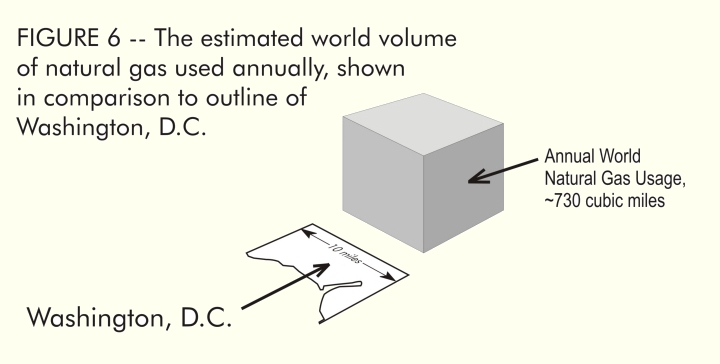
FIGURE 6 shows a 730-cubic mile cube representing current annual world natural gas production and use in comparison to an outline of Washington, D.C.
As for those ants, it has been written that the total volume of living ant tissue in the world exceeds that of humans by a factor of about ten. Even if that is so, ants simply do not compare to human beings in terms of moving things about; the use of energy from fossil sources and from hydro and wind power and the burning of wood amplifies humanity's physical presence in the world by a factor of 20 compared to our metabolic energy that comes from food.
|