|
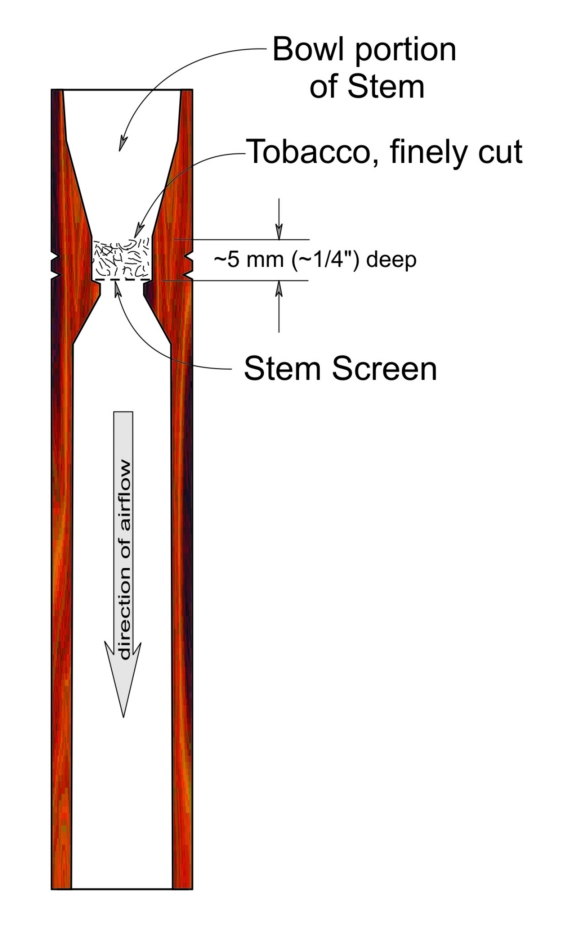
The Flash Evaporator and Pneuma vaporizing inhalers are designed to stay ON forever . . . however long that might be. The heating element operates at 200 percent of its rated power, and yet none has ever failed in over ~1,400 units that have been built (mostly Eterras); i.e., all these units use the same type of heating element. 1. Use one of those high-speed coffee bean grinders to chop up your tobacco before using it. (If it is very dry, which happens, then the grinder can turn it pretty much into powder. That is okay, except that some of the little particles can get through screen in the stem and into your mouth, which is, at the least, unaesthetic.) The ground up tobacco allows the hot air to percolate through it, thereby heating up rapidly, and yielding its volatiles into the airstream, so as to be inhaled. 2. Loading the Stem -- Here is a view of the Stem and its Bowl, showing how much tobacco should be used to achieve maximum extraction efficiency.
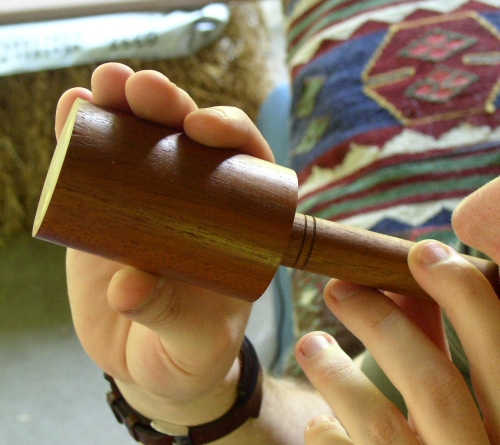
Such a small amount can, sometimes, be 'extracted' in a single inhalation. Naturally, you can load the bowl with much more, if you want, but this is adequate for efficient performance, which has always been the design criterion. 3. Invert the Pneuma when doing the first inhalation, so that particles of tobacco don't fall into the brass 'hot body,' wherein they can smolder and partly defeat the intent of these machines. |