|
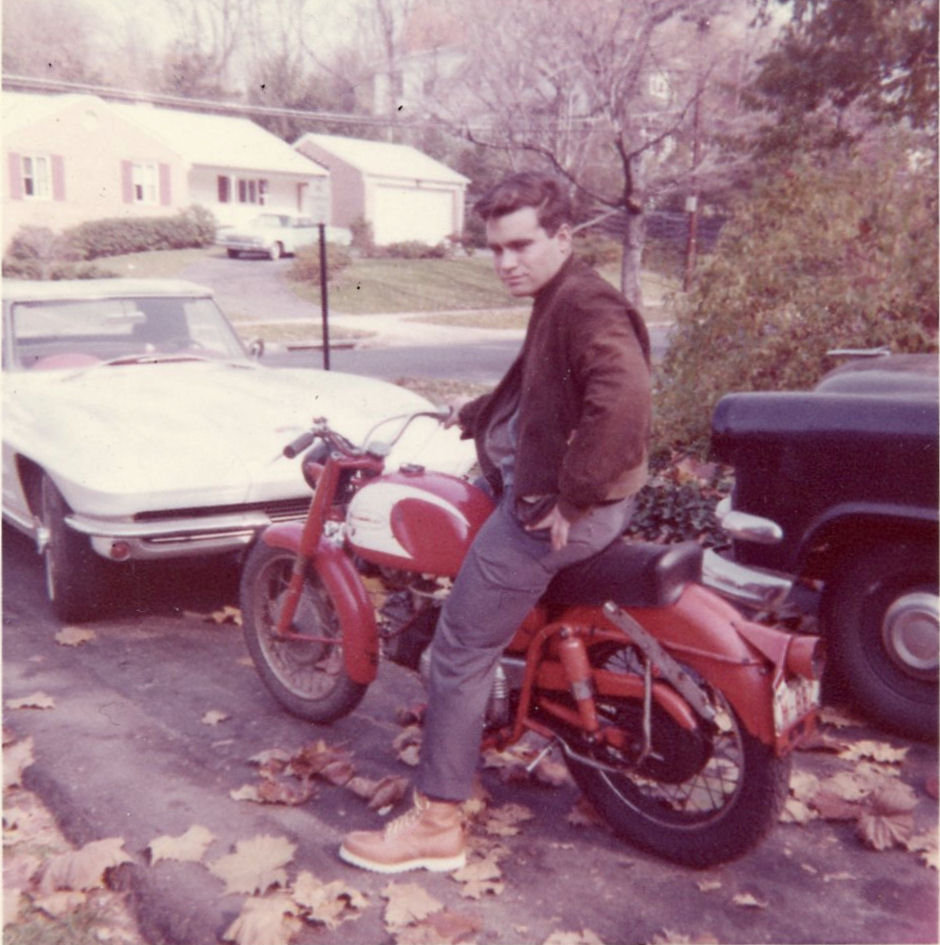
Here's the story about how the piston of a 1951 BSA
Gold Star disintegrated near Guadalajara, Mexico, 50 years ago this month, in 1964,
and some of the heroic things my ol' buddy Ron did to get the damn thing back to the
border under its own power, complete with the wrong piston, no oil pump, wooden
ball-check valve, and more.
The Mexican town we were visiting was Chapala, on the
north shore of Lake Chapala, about 40 km south of Guadalajara. That was fifty years
ago. We were visiting my uncle Glen who had retired to Chapala around 1960.
The Gulf of Tonkin thing happened on August 2, 1964, while
we were nearing the end of our stay in Chapala, both of us sick with dysentery. I
figured I'd be drafted into the Vietnam bullshit right after I finished up 3 credits
I needed to graduate college in February '65.
The visa we had in Mexico was for four weeks. It required that
the two bikes we brought into Mexico — we being my buddy Ron and me — would have to
to be taken back out of the Mexico. Ron was driving the 1951 BSA Gold Star 500 which I
he bought for $50. I was on the Sprint, late '50s or early '60s.
We spent about 10 days at my uncle Glen's house in Chapala.
The house had citrus trees and banana trees, a beautiful lawn, and, of course, servants who
got paid about a nickle a day. Summer was the "rainy season," which meant that there was
often thunder during daylight hours, even though the sky was usually sunny and bright,
but sometimes, when riding on the local roads we'd run into fifty yards of downpour, then
everything would be dry again. At night, every night, and all night, there would be
lightning flashes about once every 0.9 second.
Several times while we were staying in Chapala, Ron and I, both
of us on his bike, with the bigger engine, would ride up the hills, or mountains, north of
the lake. We could hear the engine pinging, the Mexican gas in those days being cheap and
low-octane, but we thought nothing of it.
After ten days or so, we headed out for home. Guadalajara was
the first town we'd hit on our way north. Ron and I often drove out of sight of each other.
On that day, I was several miles ahead, and after a while I slowed to see him come into view
behind me, but he didn't. So I slowed more, then stopped and waited, then turned back to
see what had happened.
Ron was sitting by the side of the road eating one of his
sandwiches when I got to him.
Engine oil, he said, was not returning to his tank. I can't
remember how he said he'd discovered that, though maybe the sump full of oil somehow gave
an indication.
We 'limped' back to Chapala, with splash lubrication. We took
the engine apart that day.
Here's the damage: One of the thrust faces of the piston had
broken off, and small chunks of aluminum had jammed up the oil pump and caused the gear teeth
of the pump's drive shaft to shear off. It seemed plausible the low-test gasoline had done
a job on the engine.
To me, it seemed obvious we would abandon the BSA and
somehow get out of the country on the Sprint. No, said Ron.
We'd have to get the parts sent to us. There were two
telephones in Chapala. One belonged to some rich guy, the other was at the drug store
on the main street of the town.
We called our girl friends in Bethesda, Maryland, saying we
needed a 0.010" oversized piston (which was an unusual oversize), one oil pump and an oil
pump drive shaft, and a set of 0.020" rings, of which we figured we could grind down the ends of
make them fit. We said we'd settle for a standard piston, if a 10-over couldn't be found.
The parts arrived about five days later. We received one standard
size piston, the 0.020-over rings, an oil pump, but no oil pump drive shaft. I said something
like, "C'mon man, forget this. Let's get outta here." No, he said.
It was probably Ron who got the idea of using ball check valves
in an improvised oil system, using the tire pump we had with us to alternately pressurize and
evacuate the oil tank — which meant Ron would have to be pumping oil with one hand when riding.
My uncle Glen had been my mentor in using tools and fixing
machinery. He had been an aircraft mechanic, working on the Vickers Viscount with Rolls Royce
engines. I inherited Glen's Whitworth tools when he had retired to
Mexico. Whitworth came in handy on my old Triumphs, till the standards were changed sometime
in the 1960s.
Uncle Glen had no power tools in Mexico. He had hand-powered
wood-working tools, a little hand-crank drill and some shitty drill bits for wood, plus a couple
of flat bastards for wood, some sand paper, a screwdriver or two, that sort of thing, and a
little hand jigsaw. Maybe a hacksaw. He had no metal suitable to making ball check valves
and seats. The ball check valves would have to be of wood. Ron persevered. I said it was
bullshit. But Ron made a wooden check-valve system. Uncle Glen was amazed at the audacity and
cleverness of the thing. (Glen had ridden Indians in the 1930s; he had stories about things
like leather rod bearings.)
We ground down the piston rings somehow, probably scraping them
on concrete. We put the piston on the rod, then slapped the cylinder in place. Ron was starting
to put the head in place, and I suggested he crank the engine through once or twice to make
sure everything went smooth. I recall him objecting to that for some reason but then he did it.
The piston came up to the top of the cylinder — then it kept rising
yet higher, by 3/8th of a inch!
"C'mon, man, forget this," I said. No, he said.
He scrounged up some eighth-inch Masonite, said he was going to
make thick spacers to go between the cylinder and the block. I pointed out the pushrods would
have to be lengthened, too. No sweat, Ron basically said. We had less than a week left to
get 700 miles to the border and out of Mexico.
Ron found some small pieces of half-inch round steel rod, which we
somehow cut to the right length and somehow drilled holes in to stabilize them on top of
the tappets and under the pushrods. It worked.
We — actually Ron, because he was the persevering force — got the
engine together, then started it up.
Flames shot out from between the cylinder and head, as had
happened when we'd originally assembled the bike before our journey to Mexico, but that
stopped after a minute or so of engine operation. The main interesting thing was all the
banging noise of the undersize piston, but it seemed to hold up. And, of course, Ron had to
pump the oil by sitting sideways and using his left arm to work the tire pump up and down.
We rode a mile or so around the town that night, then began our trip home the next morning.
We'd decided to cut a 100 miles off our route north by using
unpatrolled roads across central Mexico.
Things went mostly fine that first day out. Mostly. I still had
bad enough dysentery that I had to stop every 20 miles or so to drain water out of my ass.
That dysentery is pretty much why, I think, my guts have been fucked up ever since, 50 years
now. That's the main reason I don't travel these days: chronic abdominal discomfort.
Still, despite the dysentery, the desert in the rainy season
was unexpectedly beautiful; from high elevations of the road you could see the desert landscape,
with mesas, all green.
Every 30 miles or so, we had to stop also so Ron could tighten up
the nuts that held the cylinder to the block; otherwise you could see the cylinder rocking
around on the block.
We got about 200 miles north, and Ron finally ran out of slack
in the extended pushrods. We were in the true heart of nowhere.
We sat on an embankment with some sort of brush on the top.
Across the road, the view opened out into a plane across which we could see ten miles or more.
Previously, when we'd stopped by the side of a road, "Indian" kids, locals who lived in the
open country, would show up out of nowhere. But not this time.
We ate the last of our sandwiches and were running out of water.
Naturally I suggested we ditch the damn bike in the brush and forget it. Ron said no. So we
sat, waiting maybe to flag down a truck to help us out. It was a nice road, newish, but no
vehicles came along. Nothing, there was no traffic at all.
It was obvious we were going to have to push the bikes down the
road. (We had no way to tow the one with the other, though probably we could've figured
something out.)
The road was sweeping to the left where we had stopped. Then
it swept to the right. Then, about half a kilometer down the road was a stop sign where the road
ended and another ran east and west. A road sign said, Zacatecas, arrow pointing to the right,
about half a kilometer away, though no town was visible. Zacatecas was over a rise and just out
of view and down a hill. We coasted down the hill, and right at the bottom was the Zacatecas
train station. Zacatecas is the capital of the state of Zacatecas.
I'll cut the rest of it short now. I was pretty sick, my asshole
being sore from all the water flowing out of it, almost clean enough to drink. Still, I'm
normally a fastidious person, even with clean water coming out of me, but I felt so lousy
that when I ran out of paper to wipe with, I would just dump then pull my pants up and feel
none the worse for it. It's amazing how fast you can adapt to things.
We had to spend the night in the tiny train station, which had
at least a hundred-thousand flies on the ceiling and toilets that hadn't been flushed in
half a century it looked like. There was an old Mexican farmer dozing on a bench,
unperturbed by the flies walking all over his face. We met a girl named Hortensia
("Ortensia") with her mother, and they shared some watermelon with us. It was a long night.
The train was supposed to come at 6 a.m., but it arrived at 9 or
so. We had first class tickets, which cost about 30 pesos, about $2.
The train averaged 15 mph and went about 150 miles west that
day, to Torreon. I was very sick that night and pretty much passed out in a relatively nice
hotel while Ron went to flirt with the girls at the local serenada, which is a thing where the
girls walk one way around the town square and the boys the other, giving flowers to the girls
they liked.
The next day we went about 200 miles to the north and mostly east,
to Saltillo, or Monterry, I can't remember. The next day we got to Piedras Negras, across the
border from Eagle Pass, TX. We had to bribe the train people to give us our bikes that night.
We sent Ron's bike home by Railway Express, from Eagle Pass. Then
we both rode on my little bike — which got across Texas, Louisiana (where the steering damper
broke), and Mississippi, and a few miles into Alabama before the rear tire blew at about 60 mph.
Spokes had pulled loose from the load on the wheel, and the inner tube got punctured. It was
amazing how I handled the bike — pure luck, I think — as its rear end fishtailed back and forth
so fast I was sure Ron had fallen off.
We found an old black farmer who gave us his used and straightened
nails so we could make a crate for the Sprint and ship it home. We tried to hitchhike in the
rain. Got picked up by a drunk who was steering with his elbows and he drank and rolled
cigarettes. Then we took a bus home.
There were more details, but I'll spare you.
Oh, one more thing: We decided to never take a trip like that again.
But the following summer, we'd forgot the horror — or I'd forgot it, the Mexican trip seeming
in retrospect so glamorous — we decided to try for Alaska, me on a Triumph 500, Ron on a 650.
It rained all the way to Ontario, so we took in the Canadian National Exhibition in Toronto,
then headed back home.
And one other thing: To avoid being drafted into a shit-hole war
in Asia (this was before I got a job teaching math and physics, which gave me a draft deferment)
I tried to get into the Air Force as a pilot. But the AF could see my heart wasn't in it,
so they said I was color-blind (which I'm not) and rejected me. Around the beginning of 1965,
Ron, who had also just got out of college, told me he hadn't applied for any jobs, what should
he do. I suggested the Air Force, which he joined. He became an F-4 pilot, did two "tours" of
Vietnam, became a Top Gun pilot, called himself a steely-eyed killer, said bombing, stafing,
and napalming were the neatest thing in the world. He retired as a colonel. Steely-eyed asshole
is how I came to think of him, though I have to grant Ron his perseverance and sheer doggedness
in what seemed to me a technically hopeless situation. I haven't seen him in more than 40 years.
But I'm still good friends with his younger and more liberal-minded brother George who, with his
wife Anne, lived without electricity for 18 years in the woods of northern Pennsylvania where they
raised a family.
March 30, 2014 — THE PHANERON ON THE HOLODECK
|